
Why the Consciousness Debate Never Ends: A DRT Perspective

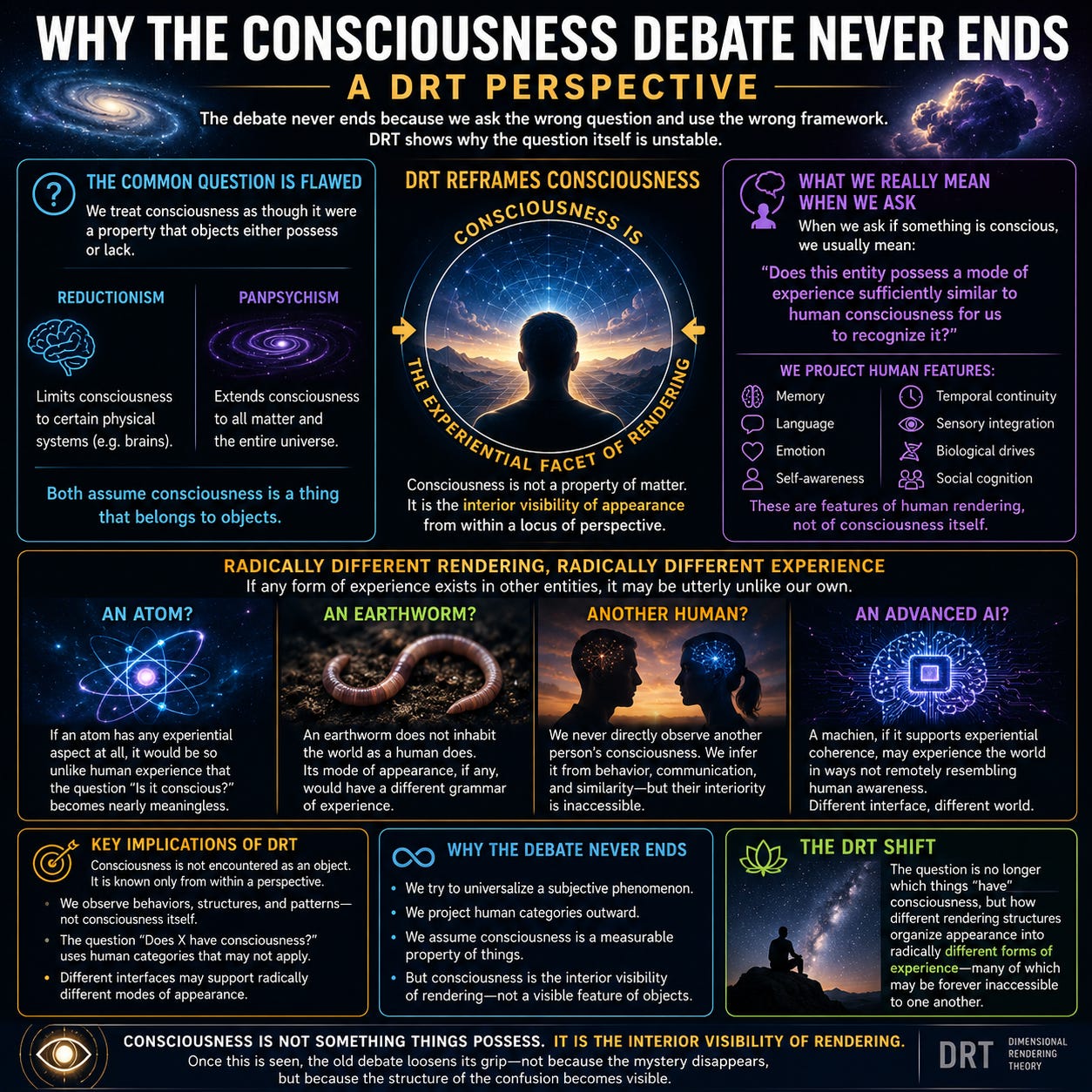
KEY POINTS
Consciousness is not a property that objects either possess or lack.
Human beings project specifically human features onto the consciousness debate.
Different rendering structures may produce radically different modes of experience.
We never directly observe consciousness in others, only behaviors and patterns.
The question “Is it conscious?” becomes unstable across radically different forms of organization.
Consciousness is the interior visibility of rendering from within a locus of perspective.
Few philosophical debates persist as stubbornly as the question of consciousness. Is consciousness produced by the brain? Is it fundamental to reality? Do animals possess it? Do machines? Are atoms conscious? Is the universe itself conscious?
The reason the debate never ends may be simpler than most people realize.
The question itself is unstable.
Within ordinary discourse, consciousness is treated as though it were a property that objects either possess or lack. A human being is conscious. A rock is not. A dog perhaps possesses “less” consciousness than a human. An advanced AI may someday “gain” consciousness. Panpsychists extend consciousness to all matter, while materialists restrict it to certain biological systems.
Dimensional Rendering Theory (DRT) proposes that both approaches inherit the same foundational confusion.
They treat consciousness as a thing belonging to objects.
DRT reframes consciousness entirely.
Consciousness is not a property of matter, nor a cosmic substance permeating the universe. It is not hidden inside atoms, neurons, or quantum fields.
Consciousness is the experiential facet of rendering itself—the interior visibility of appearance from within a locus of perspective.
This changes the structure of the debate completely.
When human beings ask whether another entity is conscious, what they usually mean is not whether any experiential mode exists at all. What they really ask is this:
Does this entity possess a mode of experience sufficiently similar to human consciousness for us to recognize it?
That is a very different question.
Human consciousness is shaped by extremely specific rendering constraints: embodiment, memory, temporal continuity, sensory integration, language, emotion, self-modeling, biological drives, and social cognition. We unconsciously project these features into the definition of consciousness itself.
As a result, when people ask whether an atom, an insect, an earthworm, or an AI is conscious, they often imagine some diminished version of human awareness—a faint little mind hidden inside matter.
But this framing may be fundamentally mistaken.
If consciousness is the experiential facet of rendering, then radically different rendering structures may correspond to radically different modes of appearance. The difference between an atom, an earthworm, and a human being would not simply be a difference in the amount of consciousness present. It would be a difference in the very grammar of experience itself.
From this perspective, the question “Is an atom conscious?” begins to collapse under its own assumptions.
An atom does not possess language, memory, narrative identity, emotional self-reflection, or sensory integration in anything resembling the human case. If some form of perspectival rendering exists there at all, it would be so utterly unlike human experience that the comparison itself becomes nearly meaningless.
The same applies, to lesser degrees, even across biological life.
An earthworm does not inhabit the world as a human does. A bat does not inhabit the world as an octopus does. Even among humans, no consciousness is directly accessible from the outside. We infer consciousness in others through behavior, communication, and structural similarity to ourselves, but consciousness itself is never externally observed.
This is one of the deepest implications of DRT.
Consciousness is not encountered as an object within the world.
It is encountered only as the perspective through which a world appears at all.
This means we never directly observe consciousness in another person, animal, or machine. We observe behaviors, patterns, reactions, speech, and structures appearing within consciousness. The interiority itself, if present, is inaccessible from outside its locus of perspective.
The debate over consciousness therefore becomes trapped between two impossible positions.
Reductionism attempts to explain consciousness entirely through external structure while never being able to bridge the gap to lived experience itself.
Panpsychism attempts to solve the problem by distributing consciousness universally across matter, but often without clarifying what “consciousness” could possibly mean across radically different forms of organization.
DRT avoids both extremes by dissolving the hidden assumption beneath them.
Consciousness is not a measurable property assigned to objects from outside. It is the organization of appearance around a perspective-capable interface.
This does not mean atoms are definitively conscious. Nor does it mean they are definitively unconscious. The category itself may fail at that scale because human concepts of consciousness are inseparable from specifically human rendering constraints.
The same caution applies even when speaking about artificial intelligence.
An advanced AI system, if capable of supporting experiential coherence at all, would not necessarily experience the world in ways remotely resembling human awareness. The mistake lies in imagining consciousness as a single universal substance distributed in varying quantities throughout reality.
DRT suggests something stranger.
Different interfaces may support radically different modes of appearance, none of which can be fully translated into one another.
This is why the consciousness debate never ends.
Human beings attempt to universalize a fundamentally subjective phenomenon while having access only to their own locus of perspective. We then project human experiential categories outward onto matter, animals, machines, and the cosmos itself.
But consciousness is not a visible feature of objects.
It is the interior visibility of rendering.
Once this becomes clear, the old debate begins to loosen its grip. The question is no longer which things “have” consciousness, but how different rendering structures organize appearance into radically different forms of experience—many of which may be forever inaccessible to one another.
The mystery remains.
But the structure of the confusion becomes visible.
These ideas are developed in much greater depth in Dimensional Rendering Theory, available on Amazon.
